
Why Fringe is the best tv series ever
Don't argue with me. I'll fight you.

I return to the same books, movies and television shows often, as I suppose many of us do, because they bring comfort and predictability in uncertain times.
There has never been a time in the history of the world when life was not uncertain in one way or another, but right now, especially in our own country, we seem to be poised on the edge of a knife. Economy, culture and foreign relations all seem particularly fraught. And like all the writers I know, I often escape into stories to give my brain and emotions a rest, and to make me experience the restorative power of creativity.
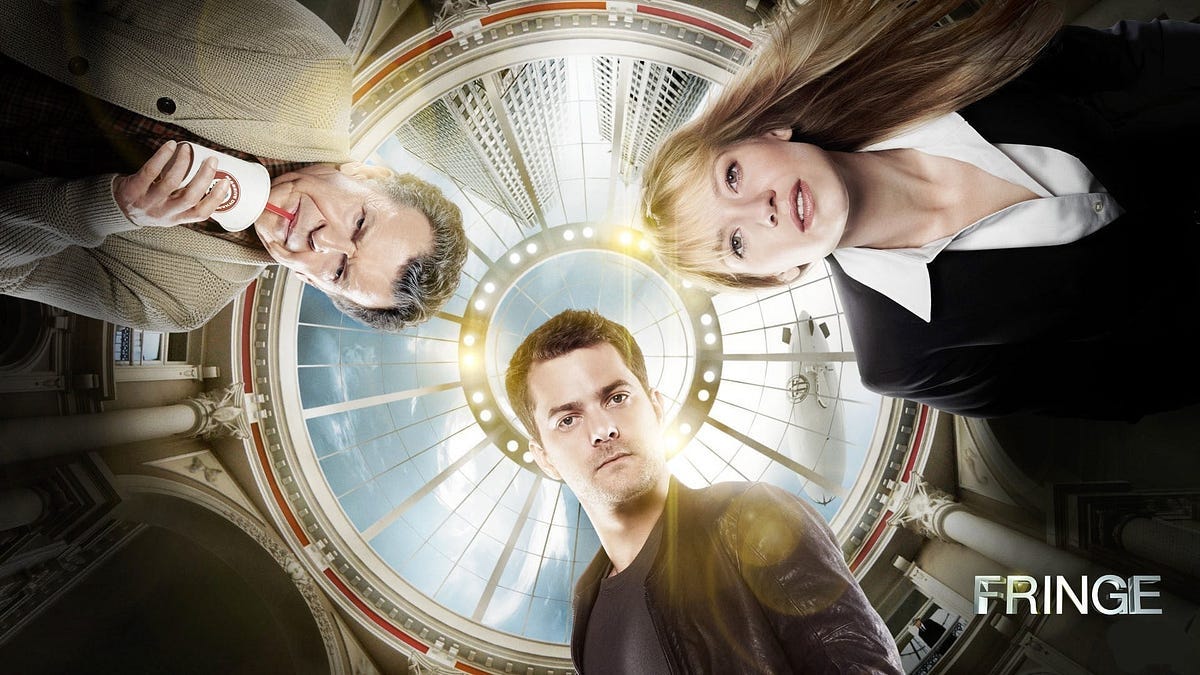
For me, one of those stories is the television show Fringe, which ran for five seasons, from 2008 to 2013 on Fox in the US. I watched the first four seasons for the first time on Netflix in 2012, just as the final season was launching, and when I went through those four seasons, I quickly bought season 5 on Apple TV because I couldn’t wait to find out what happened. Since then, I’ve probably watched the whole thing about ten -nope, eleven or twelve - times.
As an aside, rewatching (or re-reading) stories is perfectly reasonable to one of my great literary heroes, C.S. Lewis. I’ll quote him here, although in fairness, he thought the visual medium was “sickly” and so he might be affronted if he knew I was using a quote about books to support my case. What he doesn’t know won’t hurt him, I figure.
“The re-reader is looking not for actual surprises (which can come only once) but for a certain surprisingness. The point has often been misunderstood…We do not enjoy a story fully at the first reading. Not till the curiosity, the sheer narrative lust, has been given its sop and laid asleep, are we at leisure to savor the real beauties. Till then, it is like wasting great wine on a ravenous natural thirst which merely wants cold wetness. The children understand this well when they ask for the same story over and over again, and in the same words. They want to have again the ‘surprise’ of discovering that what seemed Little-Red-Riding-Hood’s grandmother is really the wolf. It is better when you know it is coming: free from the shock of actual surprise you can attend better to the intrinsic surprisingness of the *peripeteia.” C.S. Lewis, “On Stories,” Of Other Worlds [*plot structure]
So, let’s just call it the story, then, which starred Australian actors Anna Torv, who played FBI agent Olivia Dunham, and the brilliant John Noble as Walter Bishop, the central mad scientist character. Canadian-American actor Joshua Jackson played Walter’s estranged son, Peter. Lance Reddick (now passed away) played Olivia’s boss, Phillip Broyles, and Jasika Nicole played FBI agent Astrid Farnsworth, who became Walter’s defacto lab assistant throughout the series.
It was created by Alex Kurtzman and Roberto Orci (of Star Trek fame) along with J.J. Abrams, who I am convinced is a freaking genius. Classed as paranormal and science fiction, it didn’t gather a huge audience, but like the original Star Trek, developed a small and vocal cult following who kept it on the air. This cult following apparently spawned two six-part comic book series, an alternate reality game, and three novels. I had no idea these things existed until I read it in Wikipedia. Is Santa reading this, by any chance...?
With recurring appearances by Leonard Nimoy, whose character, William Bell, casts a long and ominous shadow over the storyline, the connection to Star Trek is complete.
Shot in Toronto, New York City and Vancouver, the story is set in Boston, and centers on an FBI section called “Fringe Division” which investigates strange phenomena.
If you haven’t seen it, and weird science-fictiony gore and mayhem are not your thing, I’ll warn you that most of the episodes are truly disgusting - no one in my family would ever watch it with me. At the 2012 San Diego Comic Con, Joshua Jackson said that he nearly “lost his lunch” a couple of times: once when staring at an eyeball that had been removed from a victim, and once when the design crew had created dummies of dead bodies on a beach, with six-foot genetically-modified nematodes emerging from their mouths.
The five season run covered crazy scenarios and ridiculous plotlines: shape shifters from an alternate universe who killed people and stole their appearance by sticking some strange contraption in their mouths; humans who were altered to experience various impossibilities including spontaneous combustion, harnessing electricity, influencing other people’s emotions and actions for nefarious purposes, emitting airborne viruses to kill everyone around them, ingesting worms that when consumed would grow in the body cavity and explode out of the poor, hapless soul’s stomach - I could go on, but I won’t, in case you’re eating.
For many of you who haven’t the least bit of interest in watching something like this, I’m sure you’re asking, “Umm...why? Why could this possibly be your favourite show of all time?”
Because like all good television, books and movies, the plotline is not really the story. The story is a throughline that keeps you watching, despite the silliness on the surface, which in this case never takes itself too seriously and supplies a lot of humour. The central question of Fringe is actually “What does it mean to be human?”
The answer of course, is love, which is both an action and state of being that is lost on the antagonists of the show. To be human is to pursue unconditional love (which of course, for me as a Christian, is a divine attribute). How far would a father go to save his son? Can he be forgiven for those actions if he went too far? Can love bring you back from the brink of insanity, or help you overcome hopelessness, or the isolation that comes from childhood trauma?
I so loved the central relationship between Walter and his son, Peter, played with such sensitivity, humour and vulnerability by John Noble and Joshua Jackson. The writing of these scenes is top-notch, and I still cry when I watch the last episode. Just before Walter does something heroic, he says to his son, “You’re my very favourite thing, Peter. My very favourite thing.”
I cry because that’s how I feel about my own children, and there isn’t much I wouldn’t do for them. Of course, Walter is a genius, and can do quite a bit more than I can, but still, I feel the same way. Like I could do the impossible too, if I had to, because I need to save my kids.
And that’s the thing about good stories. They fill you up. They energize you, and allow you to pour out that inspiration into everything else you do.
Dude, I wish I’d written that. I wish I could write that.
Perfectly succinct. I am on season 4 right now, for my 5th time rewatching. Love, family, bonds. Even Schitts Creek emulates that which we all want and need. Thank you for writing this; I love when someone else understands my love, for love. And also sci-fi and Spock 🖖 and Mr. Noble is one of the BEST actors out there. I love this show so much. Those who stumble upon this.... it's a must watch. Get through the monster of the week stuff and then see what happens. It warms my soul and makes me think of my dad and how he moves worlds for me